
Learning the guzheng: a beginner's guide
What learning the guzheng actually involves, from a teacher's point of view: the instrument and its five-note scale, whether you need musical experience, what the first lessons cover, how hard it really is, practice, and when children and adults can start.
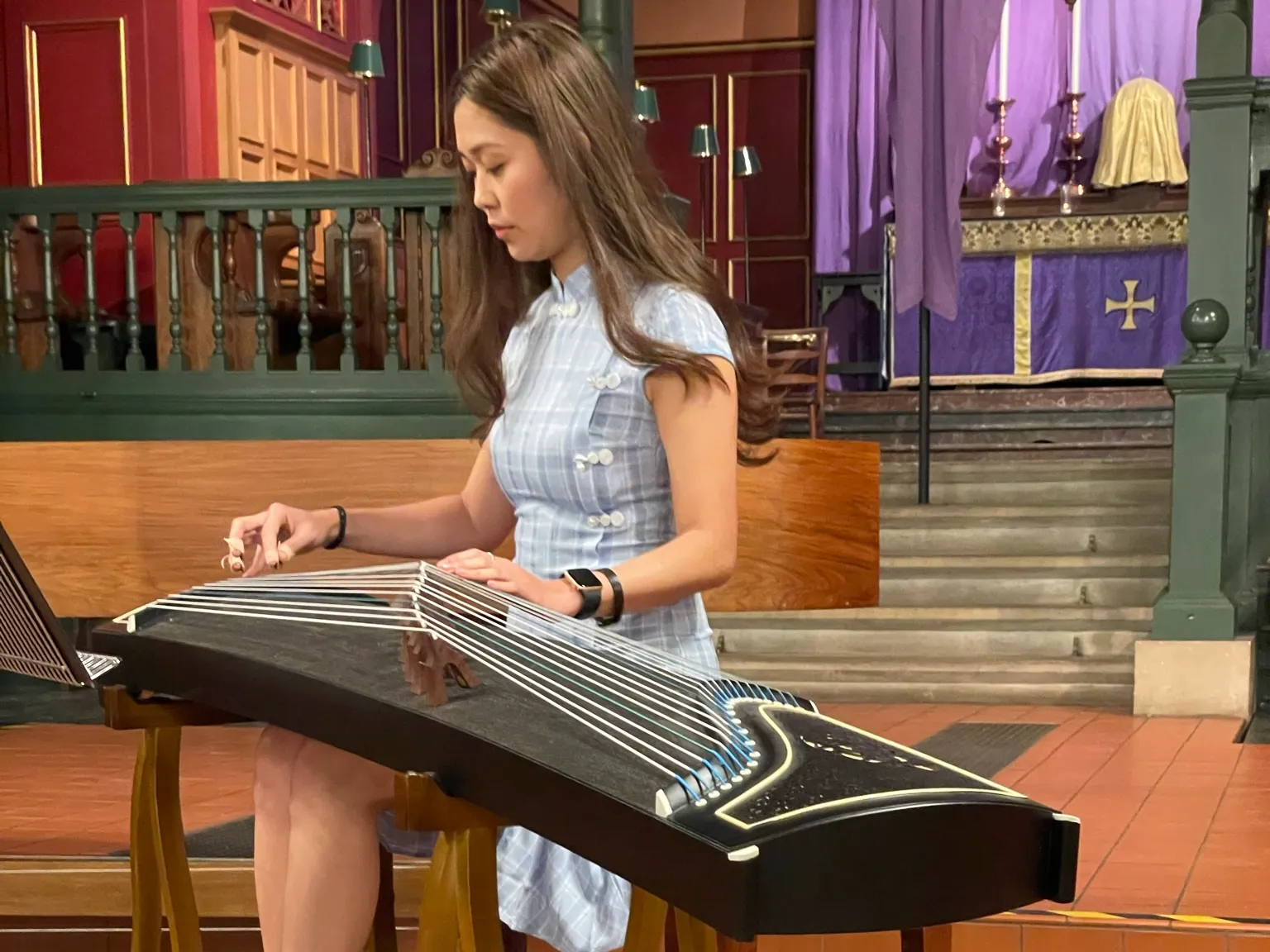
Table of contents
If you are thinking about learning the guzheng, you probably have a few practical questions first. Do you need to have learnt music before? Is it difficult? Do you need your own instrument? How much practice does it take? And is it for children, for adults, or for both?
I teach guzheng and piano at Cantus Silvae Music Studio in Singapore. These are some of the practical questions beginners often have, so here are my answers.
What is the guzheng?
The guzheng (古筝, gǔzhēng) is a Chinese plucked zither. Most modern instruments have twenty-one strings, and each string rests on its own movable bridge, which sets its pitch. You play it seated, with the instrument on a stand in front of you. Your right hand plucks the strings, and your left hand presses them on the other side of the bridges to bend notes and add vibrato. Those left-hand pressings are a large part of what makes the guzheng sound the way it does.
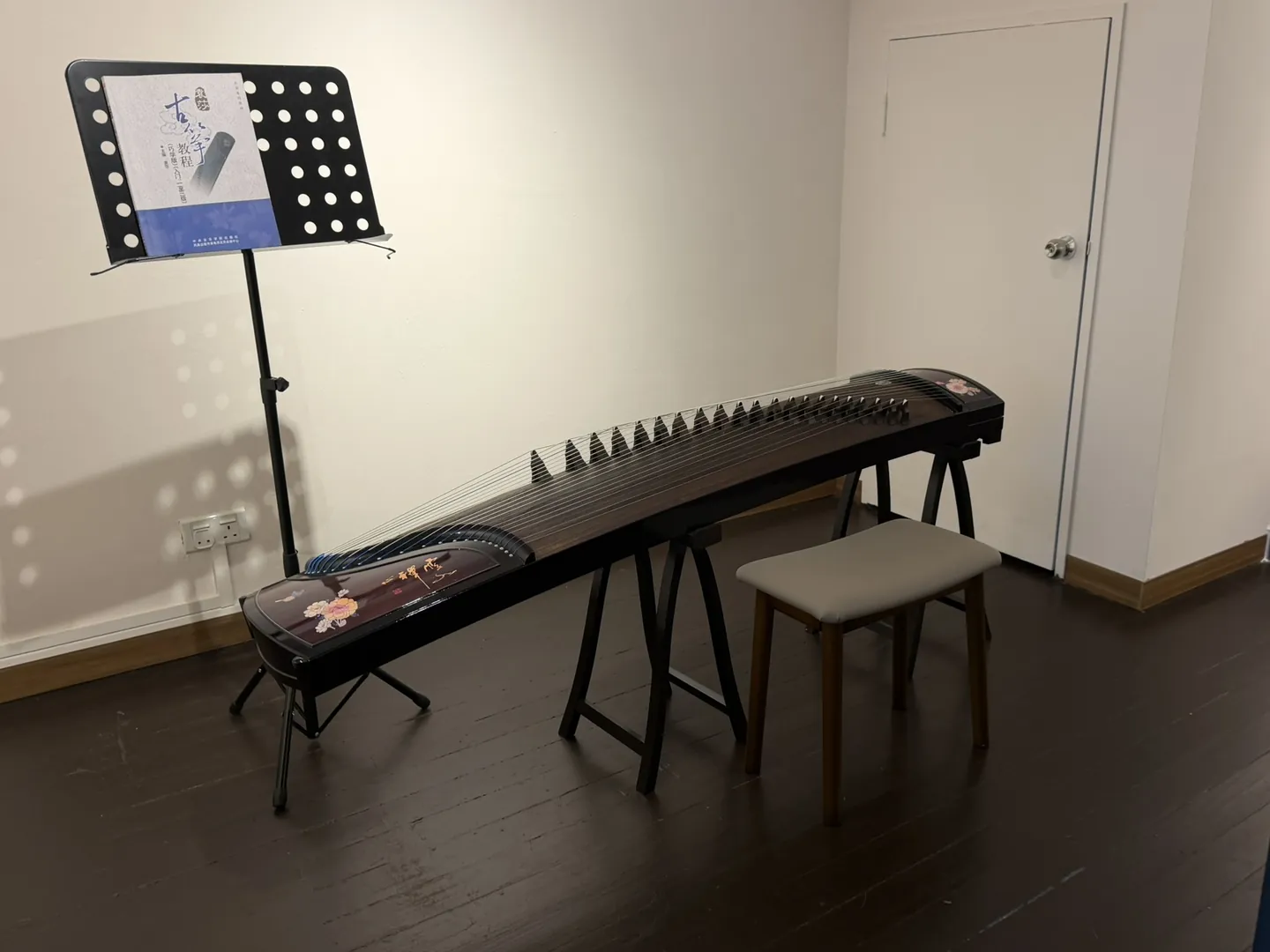
The instrument has a history of more than two thousand years. It is sometimes confused with the guqin, a quieter seven-string zither without bridges, because of the similar name.
Do you need musical experience to learn the guzheng?
No. You do not need to read music or to have played another instrument before your first lesson.
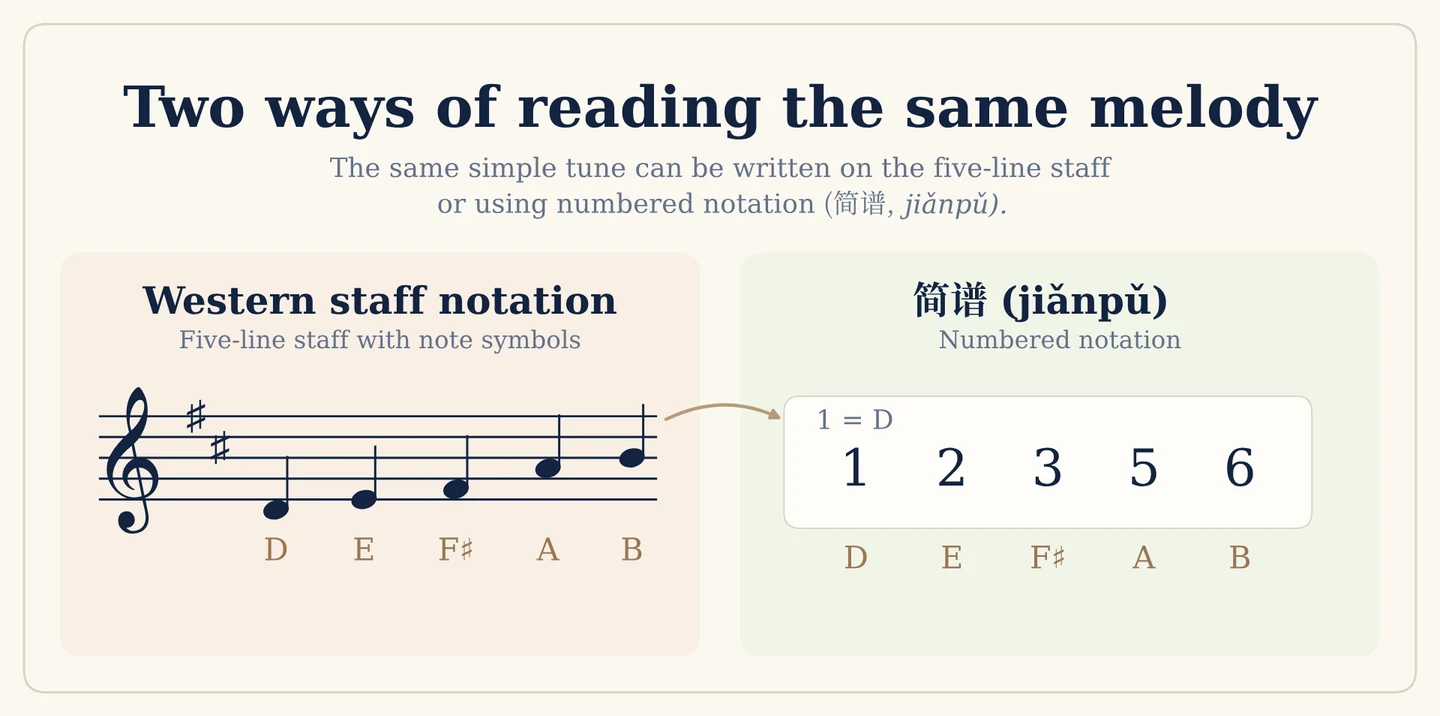
When I teach a complete beginner, I introduce two things early. The first is the scale. The guzheng is commonly tuned to a pentatonic scale (五声音阶, wǔshēng yīnjiē), five notes to the octave, so the notes you pluck in your first lessons already sound as though they belong together.
The second is the notation. Instead of the five-line staff you may associate with Western music, most guzheng music is written in numbered notation, called jianpu (简谱, jiǎnpǔ), which uses numbers for the notes. If you can recognise numbers, you can begin to follow a line of music. Reading it is something you learn in your lessons, not something you need to know beforehand.
What do you learn in your first guzheng lessons?
When I teach a complete beginner, I usually work in this order: reading the notation and plucking first, then hand technique and posture.
- Reading the notation, so that from the beginning you can follow what you are playing.
- Plucking. You begin with basic plucking strokes and learn how to put on and use the fingerpicks.
- Hand technique and posture: how to sit at the instrument, the shape of your hand, where on the string to pluck for a good tone, and, as you progress, the left-hand pressing that bends and colours the notes.
Is the guzheng difficult to learn?
My answer has two halves.
Starting the guzheng can feel relatively approachable. The strings are commonly tuned to a pentatonic scale, and numbered notation gives beginners a straightforward way to start reading music. The more demanding part is developing good technique.
A clean, even tone from each stroke, accurate left-hand pressing so that a bent note lands in tune, controlled vibrato, and coordination between the two hands all take patient work, and that work is where lessons matter most. So the guzheng is approachable to begin and demanding to play well.
I would be cautious about comparing it with other instruments. Every instrument is hard in its own place, and which one suits you depends on you, not on a ranking.
How much should a beginner practise?
My recommendation: 10–15 minutes every day.
As your pieces become longer or more demanding, your practice time can gradually increase.
Do you need to own a guzheng?
Not before your first lesson. Having an instrument at home is useful, because it makes regular practice possible. In my experience, owning one becomes especially important when you are preparing for a grading examination.
When you do choose one, the things I consider most are the type of wood and the quality of the sound. Choosing a first guzheng deserves an article of its own.
What age can children start learning the guzheng?
In my experience, children can generally begin at around four to five years old. My practical test is whether the child can recognise and read numbers, because that is what numbered notation asks of them.
Younger children are usually more curious, so I bring in more games, imagination and storytelling.
Can adults learn the guzheng?
Yes. One misconception I often hear is “I am too old to learn the guzheng.” I do not consider age in itself a reason that an adult cannot start.
With adults, I generally take a more logical and systematic approach: explaining how the scale and the notation work and why a technique is done a particular way, and building from one step to the next. As with children, no musical background is needed.
Starting the guzheng
In short: you do not need previous musical experience or your own instrument before your first lesson, and children and adults can both begin.
I teach individual guzheng lessons for children, teenagers and adults at Cantus Silvae Music Studio in Singapore. The lessons page explains how they work, and you are welcome to ask me anything this guide has not covered.
Thinking about lessons?
Individual piano and guzheng lessons for children, teenagers and adults in Singapore. Leave your details and we’ll get in touch.
View Guzheng LessonsThank you for your enquiry.
We’ve received your details and will be in touch via WhatsApp shortly.